

Advent Calendar Packaging: Why the Holiday Countdown Box Wins
Every November a brand sends one beautiful holiday box and hopes it gets opened on camera. An advent calendar sends twelve reasons to come back. The difference in engagement is not subtle, and the reason is structural: a countdown box turns a single unboxing into a series.
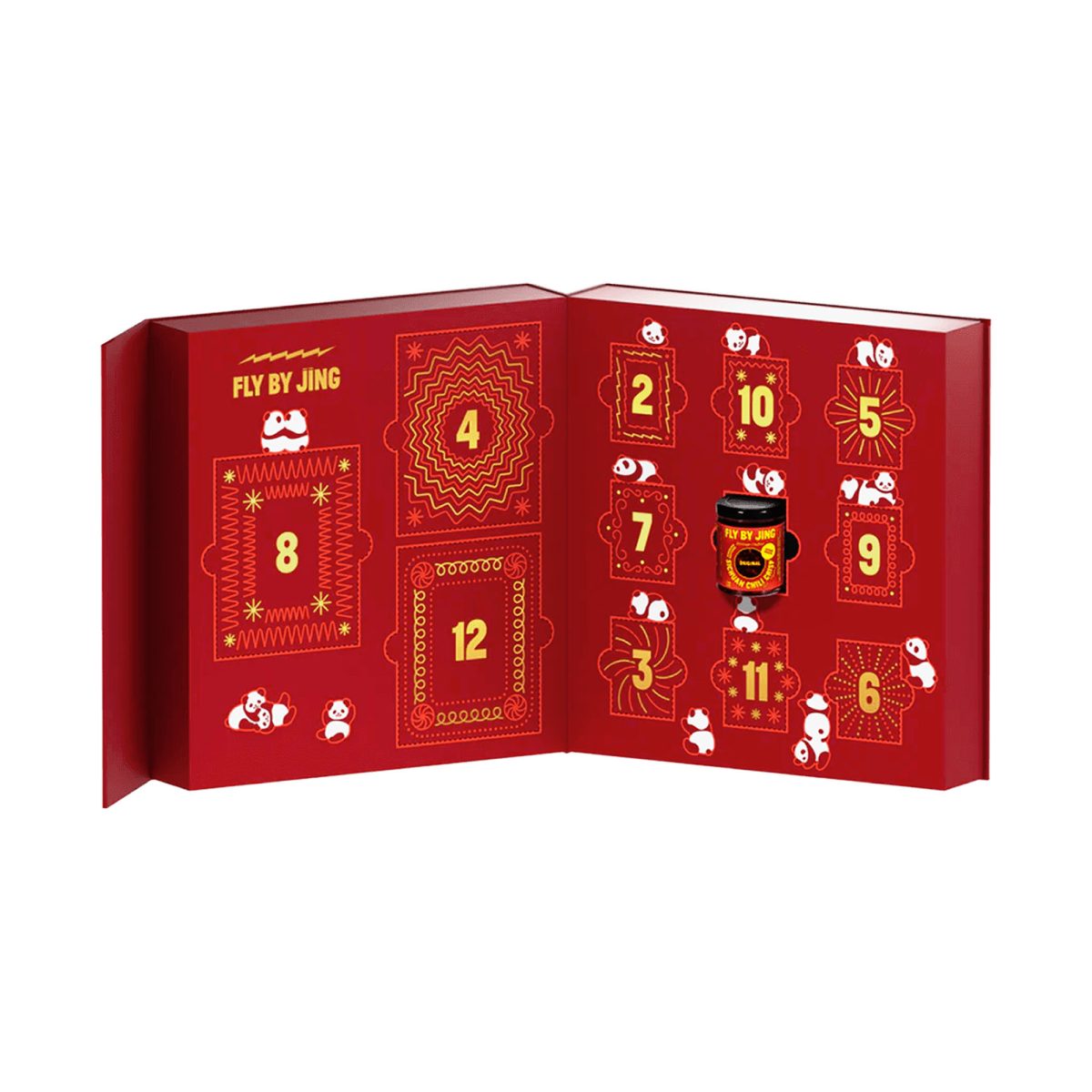
We built one for Fly By Jing, a lacquer red gatefold with twelve numbered doors and the chili crisp mascot at the center. It is on the Fly By Jing and Juni page. This post is about what we learned making it, and what a brand should know before asking for one.
Twelve Reveals Beat One
A standard PR box earns one piece of content if it is lucky. An advent calendar earns a door-a-day story, a flat lay on day one, and a finale on day twelve. Creators like them because the content plans itself. Brands like them because the product range gets shown item by item rather than as a pile.
It also changes the tone. A single box is a gift. A calendar is a ritual. Rituals get shared.
What Makes a Calendar Hard to Build
Three things. The cell grid has to be sized to the smallest and largest items at once, so the insert is engineered first and the doors are drawn around it. The doors are perforated, and perforation on a rigid box means the cover board has to be scored to tear cleanly without lifting the print. And the numbering has to survive a creator finding door seven in bad light, which argues for large numerals and strong contrast.
The Fly By Jing calendar solved the contrast problem with gold on red, and the tear problem with a laminate that stops just short of the perforation line so the door edge stays crisp.
Lead Time Is the Real Constraint
A corrugated mailer can go from brief to delivery in a few weeks. A calendar needs structural prototyping, a perforation test, and a print proof on the final board, and then a manufacturing slot in the busiest quarter of the year. For a December ship, the conversation starts in spring and the die line is approved by late summer. Brands that call in October get a very good mailer instead.
Who Should Consider One
Any brand with a range wide enough to fill the doors: sauces and condiments, tea and coffee, beauty minis, confectionery, supplements. Twelve doors is the sweet spot for a PR calendar; twenty-four is a retail product and a different budget. If the range is narrow, a six-door countdown with larger cells is a legitimate and cheaper variant.
The Short Version
A countdown box is the highest-engagement holiday format we make, and the one with the longest runway. If you want one for next December, talk to HVRLA before the current one is over. The full PR box portfolio shows what else is in the range.